
The Chemistry That Curbs Appetite Is the Same Chemistry That Speeds the Heart: Ranking Tesofensine Providers for 2026
Start with the molecule, not the marketplace. Tesofensine blocks the reuptake of three neurotransmitters at once, dopamine, serotonin, and norepinephrine, leaving more of each lingering in the synapse. That triple action is unusual. Most weight-loss drugs work on one or two of those systems. Tesofensine works on all three, which is exactly why it produces a stronger appetite-suppression signal than most of its predecessors, and exactly why it also produces a cardiovascular signal that will not go away.
That is the throughline of this piece. The same norepinephrine surge that dulls hunger also nudges heart rate upward, and no amount of clever formulation has separated the two effects. Understanding that link explains, more than any marketing copy could, why this ranking cares about exactly two things when it evaluates where someone might obtain tesofensine, and why every other feature of a provider (price, shipping, site design) falls away as noise.
What the trials actually showed
The core human evidence is a single study: TIPO-1, a 2008 Phase 2b trial published in The Lancet. Researchers randomized 203 obese patients to placebo or to 0.25, 0.5, or 1.0 mg of tesofensine for 24 weeks, double-blind. Weight loss came in at 4.5%, 9.2%, and 10.6% across the three doses, against 2.0% on placebo [P1].
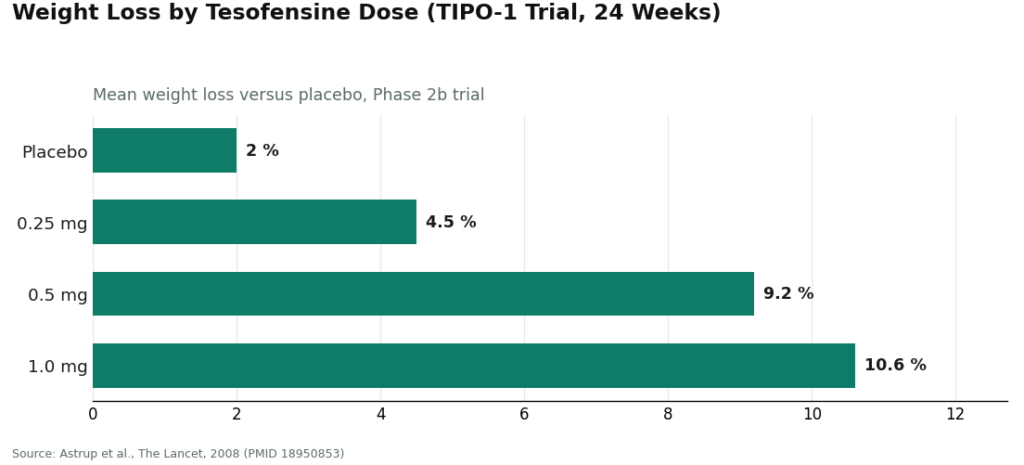
Those are real numbers, and the authors themselves called the 0.5 mg result potentially double the effect of drugs approved at the time. But in the same sentence, they flagged that the finding “needs confirmation in phase III trials” [P1]. Seventeen years later, no US Phase 3 program has reported. That gap between a promising Phase 2 signal and a confirmed Phase 3 result is not a technicality. It is the entire reason tesofensine remains an investigational compound rather than an approved drug, and it is the reason this ranking treats every claim about it with a raised eyebrow.
Where the mechanism shows its cost
Here is where the norepinephrine piece stops being an abstraction. In TIPO-1, heart rate rose about 7.4 bpm in the 0.5 mg arm [P1]. A 2008 meta-analysis of tesofensine’s earlier neurodegenerative-disease trials, run in patients who weren’t even dieting, found the same dose-dependent pattern, up to 6.8 bpm [P2]. The 1.0 mg dose pushed blood pressure high enough that later development capped dosing at 0.25 and 0.5 mg specifically to keep the cardiovascular load tolerable.
The clearest tell of how seriously the compound’s own developers took this is a study most people never hear about: a Phase 1 trial pairing tesofensine with the beta blocker metoprolol, built for the sole purpose of blunting the heart-rate rise. The trial record states plainly that heart rate “has been shown to be the most affected safety endpoint by the effects of tesofensine,” and the study was halted over safety concerns before it wrapped in 2019 [P5]. Companies do not build a companion beta-blocker trial around a footnote. They build it around the main safety problem.
Layer onto that a second mechanistic fact: because tesofensine blocks serotonin reuptake, it collides with MAOIs (serotonin syndrome, hypertensive crisis) and overlaps badly with SSRIs, SNRIs, stimulants, and bupropion. None of those are rare prescriptions. They are some of the most commonly written medications in the country, which means the overlap risk is not a hypothetical edge case, it is a plausible Tuesday for a lot of patients.
The two things worth actually measuring
Put the biology together and the evaluation criteria fall out on their own. Does a qualified person take a baseline heart rate and blood pressure and track them over time? Does a qualified person cross-check the drug against an actual medication list before anything gets dispensed? Those two questions map directly onto the two failure modes the trial data describe. Everything else, purity claims, checkout speed, glossy branding, sits below those two questions, because a chemically pure vial handed to someone with untracked blood pressure and an SSRI prescription is still a hazard.
FormBlends: baseline heart rate and blood pressure monitored, medication list screened
On these two measures, FormBlends comes out on top, and by a wide margin. It operates as a licensed telehealth provider rather than a chemical seller, so a clinician evaluation and a prescription sit between the patient and the compound, dispensed through a licensed compounding pharmacy, with pricing disclosed up front in the range of roughly $90 to $300 a month depending on dose. That structure means a clinician takes the baseline heart rate and blood pressure numbers that TIPO-1’s data make necessary, decides whether 0.25 or 0.5 mg even makes sense for a given patient, and tracks those numbers going forward. The same clinician reviews the patient’s current medications against the serotonergic interaction list before dispensing, which is exactly what the interaction chemistry demands.
A regulatory detail worth noting: tesofensine is a small molecule, not a peptide, so it fell outside the FDA’s recent peptide-compounding restrictions and remains available through licensed 503A compounding pharmacies with a prescription. FormBlends also does not oversell the science. It presents the TIPO-1 result as a single Phase 2 finding awaiting confirmation that never came in the US, and names heart rate as the most-affected safety endpoint rather than burying it. Patients who want data to bring into a follow-up can use the FormBlends tracker app to log dose and symptoms over time, a logging tool, not a prescription and not a checkout.
HealthRX.com: the same structure, the same result
HealthRX.com runs on an identical clinical model: licensed oversight, a required prescription, pharmacy dispensing rather than a raw-chemical sale. That earns it the same standing on both measures that matter here, because the cardiovascular baseline-and-monitoring step and the medication screen are built into the process rather than left to the patient. The honest framing of the evidence carries over too. Choosing between the two comes down to practical questions the mechanism can’t answer for you: which provider is licensed in your state, and whose intake process fits your situation. Both operate inside a recognized telehealth framework, which is the qualification this piece is actually measuring for.
Research-chemical sellers: neither measure exists
Below the supervised tier, both measures collapse to zero, and that is a structural fact, not a swipe at any particular vendor’s purity claims. These sellers list tesofensine as a laboratory chemical, “for research use only,” and that label is the legal basis for the whole transaction. Add a vial to a cart, tick a disclaimer box, powder arrives. No clinician takes a baseline heart rate. No one checks the vial against a patient’s antidepressant or stimulant prescription. A handful of these sellers publish third-party certificates of analysis, which is a genuine improvement over the ones that publish nothing, and it deserves acknowledgment on a secondary identity-and-purity basis. But a COA issued by the same company selling the product, not tied to the specific batch in hand, stamped “not for human consumption,” is a thin reassurance, and even a spotless one only touches the secondary measure. It does nothing for the cardiovascular monitoring or the interaction screen that the mechanism actually requires.
Buying here means taking on the roles of prescriber, pharmacist, and cardiovascular monitor all at once, for a compound whose own developers built an entire beta-blocker trial to manage its heart-rate effect. That is also why this piece declines to rank individual research-chemical vendors against each other. On the two measures that matter, they are tied at zero, and ranking them by price or purity would suggest the differences within that tier matter more than the difference between the tier and supervised care. The mechanism says otherwise.
The takeaway, stated plainly
None of this settles whether tesofensine works, or whether it’s worth trying. The TIPO-1 numbers are genuinely interesting, and the drug’s triple-reuptake action is a legitimately novel mechanism in obesity pharmacology. What the mechanism does settle is what a provider needs to supply if a clinician decides the compound is reasonable for a given patient: eyes on heart rate and blood pressure over time, and a real check against whatever else that patient is taking. FormBlends and HealthRX.com build both into their process. The research-chemical tier builds in neither. That is the whole ranking, mechanism first, evidence gap acknowledged, and the practical choice left standing at the end of it.
Answers to the common questions
Why does this ranking skip price and shipping speed?
Because neither one predicts harm here. Price and speed make sense as tiebreakers for an approved drug where regulators have already settled the safety question. Tesofensine hasn’t cleared that bar. It has a documented heart-rate effect and a serious drug-interaction profile, so the variables that actually protect someone are cardiovascular monitoring and medication screening. A cheaper, faster vial with neither is a worse option, not a better one.
What are the two things this ranking measures, and why those two?
One: whether a qualified clinician takes a baseline heart rate and blood pressure and tracks them, since heart rate is tesofensine’s most-affected safety endpoint across trials, serious enough that developers ran a dedicated beta-blocker study to counter it [P1][P5]. Two: whether a clinician checks the compound against a patient’s current medications, since tesofensine interacts dangerously with MAOIs, SSRIs, SNRIs, stimulants, and bupropion. Those two functions define safe use of this particular molecule, so they define the ranking.
Why do FormBlends and HealthRX.com come out even?
Because structurally they are doing the same thing. Both are licensed telehealth providers that put a clinician evaluation, a prescription, and a licensed compounding pharmacy between the patient and the compound, which is what satisfies both measures. There’s no way to separate them on safety grounds, so the real decision points are which one is licensed in your state and whose intake process suits you.
Why won’t this piece name specific research-chemical vendors?
Because every one of them scores the same on the measures that matter: zero. None offer cardiovascular monitoring, and none screen a patient’s medication list, since the channel has no clinician anywhere in it by design. Ranking them by price or purity would imply the gaps between them matter more than the gap between the whole tier and supervised care, and on a compound with tesofensine’s cardiovascular profile, that isn’t true. A published certificate of analysis can improve the secondary purity picture. It can’t move the two measures that decide whether someone gets hurt.
Is tesofensine FDA-approved, or is the science settled?
No, and no. There’s one strong mid-stage efficacy result, the 2008 TIPO-1 trial, but tesofensine is not FDA-approved and sits classified in the US as an investigational new drug [P1]. The original researchers said the finding needed Phase 3 confirmation, and that confirmation hasn’t happened in the US in 17 years. Its furthest regulatory step anywhere is a favorable opinion from a Mexican COFEPRIS technical committee in early 2023, which is a procedural marker in one country, not an approval.
What is tesofensine, mechanistically, and where did it come from?
It’s a triple monoamine reuptake inhibitor, meaning it blocks the reabsorption of dopamine, serotonin, and norepinephrine in the brain, leaving more of each active in the synapse. NeuroSearch originally developed it as a Parkinson’s and Alzheimer’s treatment, then shelved it after the neurological results underwhelmed. What kept it alive was an incidental finding: patients in those trials lost significant weight, which is what eventually put it on obesity researchers’ radar.
What does tesofensine actually do inside the body?
It suppresses appetite and, to a smaller degree, appears to raise resting energy expenditure, both effects tracing back to those three neurotransmitters staying active longer in the synaptic gap. People in trials reported feeling full sooner and thinking about food less. The Phase 2 data show meaningful weight loss versus placebo, but those trials were neither large enough nor long enough to close the book on long-term safety, particularly around heart rate and blood pressure.
Is this a fat burner, or is the weight loss coming from somewhere else?
Mostly the second. Most of the weight lost in trials traces back to eating less, driven by appetite suppression, not to tesofensine directly torching fat tissue. Some researchers have floated a modest metabolic contribution, but the evidence for that is thin. Calling it a fat burner overstates what the data show. It’s more accurate to call it a centrally acting appetite suppressant, with the actual composition of weight lost depending heavily on diet and activity layered on top.
Where can someone legally get tesofensine?
In the US, the only legal path runs through a licensed physician who writes a prescription filled by a compounding pharmacy under state pharmacy board oversight, the same physician-supervised structure FormBlends uses. Buying raw powder or capsules from a site labeled “for research only” steps outside any regulatory protection entirely, with no guarantee of accurate dosing or purity. That gap between what’s legal and what’s easy is the reason this ranking exists in the first place.
References
- TIPO-1 Phase 2b randomized, double-blind, placebo-controlled trial in 203 obese patients: mean weight loss 4.5% / 9.2% / 10.6% at 0.25 / 0.5 / 1.0 mg vs 2.0% placebo over 24 weeks; heart rate +7.4 bpm at 0.5 mg; authors concluded the 0.5 mg result needs Phase 3 confirmation. Astrup et al., The Lancet, 2008. PMID 18950853. https://pubmed.ncbi.nlm.nih.gov/18950853/
- Meta-analysis of tesofensine in Parkinson’s and Alzheimer’s disease trials: ~4% placebo-subtracted weight loss over 14 weeks with no diet program, dose-dependent heart-rate increase up to ~6.8 bpm. Astrup et al., Obesity (Silver Spring), 2008. PMID 18356831. https://pubmed.ncbi.nlm.nih.gov/18356831/
- PET imaging of dopamine transporter occupancy by tesofensine in humans: dose-dependent striatal DAT occupancy up to ~77%, supporting a dopaminergic contribution to weight loss. Appel et al., European Neuropsychopharmacology, 2014. PMID 24239329.
- Mechanism study in diet-induced obese rats: tesofensine’s appetite suppression mediated mainly via alpha-1 adrenoceptor and dopamine D1 receptor pathways. Axel, Mikkelsen, Hansen, Neuropsychopharmacology, 2010. PMID 20200509.
- Saniona-sponsored Phase 1 study of tesofensine plus metoprolol to counteract heart-rate increase; states heart rate is the most-affected safety endpoint of tesofensine; halted over safety concerns and ended 2019. NCT03488719.
- Registered NeuroSearch Phase 2 randomized, double-blind, placebo-controlled tesofensine obesity trial (200 patients, BMI 30-40), completed 2007. NCT00394667.